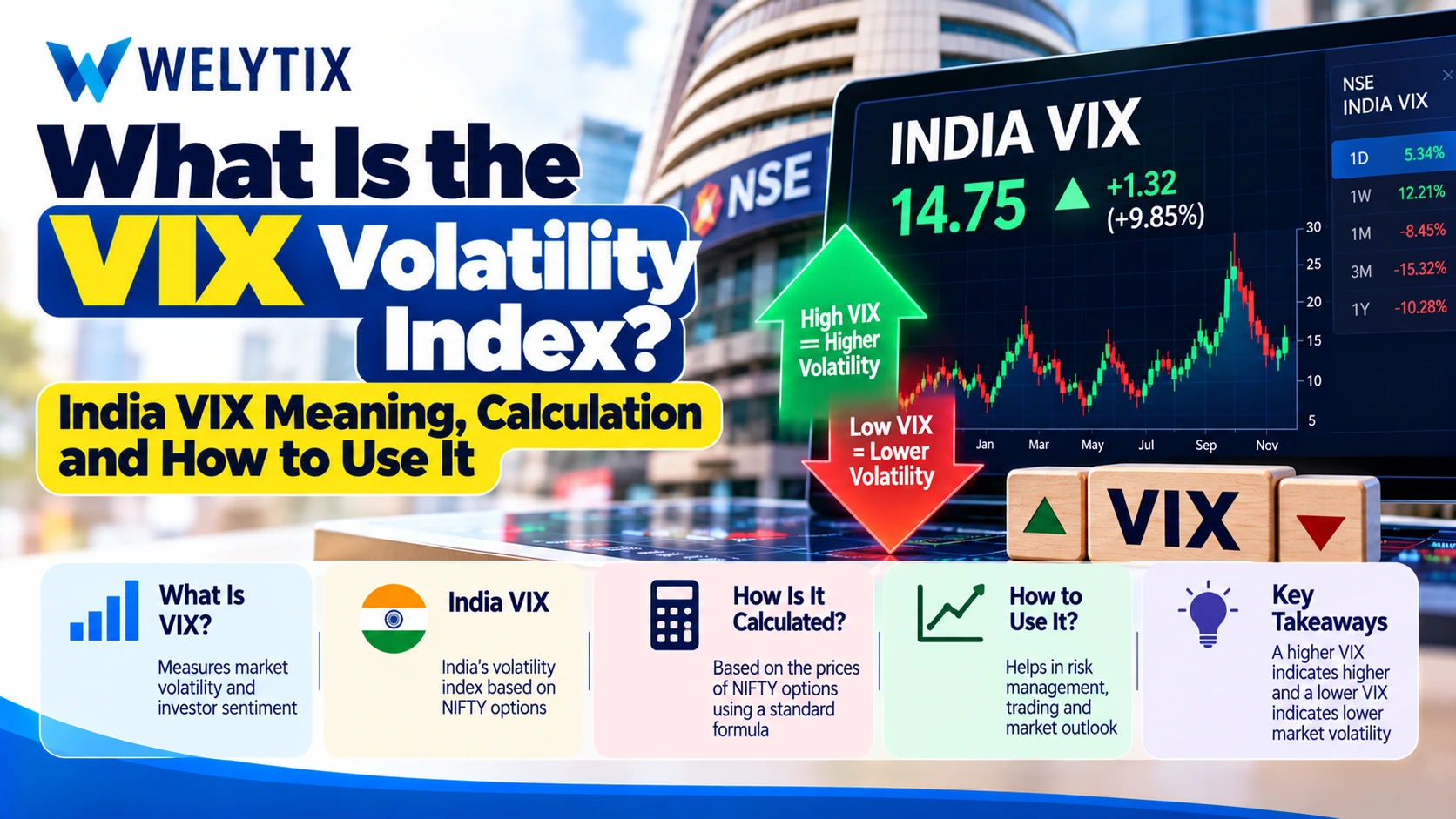
The VIX Volatility Index, often called the "fear gauge", measures how much the market expects prices to swing in the near future. In India, India VIX is published by NSE and shows the expected volatility of the Nifty 50 over the next 30 calendar days, expressed as an annualised percentage. A higher VIX means investors expect bigger swings, and a lower VIX means they expect a calmer market. Last updated: October 2026.
Quick Facts About India VIX
- India VIX is calculated by NSE from the prices of Nifty 50 options.
- It estimates expected volatility over the next 30 calendar days and is shown as an annualised percentage.
- A higher VIX signals expected large swings. A lower VIX signals expected stability.
- It measures the expected size of market moves, not their direction.
- It usually moves in the opposite direction to the Nifty 50.
- India VIX is an index. You cannot buy it directly, but NSE offers futures on it.
What Is the VIX Volatility Index?
The VIX Volatility Index is a measure of expected market volatility. It is derived from option prices, because the price of an option rises when traders expect bigger price swings and falls when they expect a calm market. By reading these prices, the index shows how nervous or relaxed investors are about the near future.
That is why it is called the fear gauge: when uncertainty rises, traders buy protection through options, option prices go up, and the VIX rises.
India VIX vs CBOE VIX
The original VIX was created by the Chicago Board Options Exchange (CBOE) for the US market. India VIX follows a similar method, adapted for Indian markets.
| Feature | CBOE VIX | India VIX |
|---|---|---|
| Market | United States | India |
| Based on | S&P 500 index options | Nifty 50 index options |
| Published by | CBOE | NSE |
| Time horizon | 30 days | 30 calendar days |
When people in India talk about the VIX, they usually mean India VIX.
How Is India VIX Calculated?
NSE calculates India VIX using the best bid and ask prices of out-of-the-money Nifty 50 call and put options for the near and next month expiries. The method follows the CBOE's approach, with changes to suit the Indian options market. In simple terms:
- NSE collects the bid and ask prices of the relevant Nifty options.
- It combines them to work out the market's expected variance, which is a measure of price swings, over the next 30 days.
- It converts this into volatility and annualises it, so the final number is a percentage.
What Does a VIX Number Mean?
If India VIX is 15, the market is pricing in annualised volatility of about 15% for the Nifty 50. A rough way to turn this into a one-month estimate is to divide by the square root of 12, which is about 3.5. So a VIX of 15 suggests a typical one-month move of around 4.3%, up or down.
Example: If the Nifty is at 25,000 and India VIX is 15, a typical one-month move would be about 1,080 points in either direction. This is a statistical estimate of expected movement, not a prediction, and actual moves can be larger or smaller.
How to Read India VIX Levels
There is no official threshold for what is "high" or "low". As a rough rule of thumb used by many market participants:
| India VIX level | What it usually suggests |
|---|---|
| Below about 15 | Calm market, low expected volatility |
| About 15 to 25 | Moderate volatility |
| Above about 25 to 30 | High uncertainty and market stress |
Treat these as rough guides, not fixed rules. It is more useful to compare today's VIX with its own recent history than to rely on a single number.
Why Does India VIX Move Opposite to the Nifty 50?
The VIX and the Nifty 50 usually move in opposite directions because of how investors behave:
- When the Nifty falls, investors worry about further losses and buy put options to protect their portfolios. This demand pushes option prices up, which raises the VIX.
- When the Nifty rises steadily, the demand for protection falls, option prices ease, and the VIX falls.
The relationship is a tendency, not a rule. Sharp falls usually push the VIX up more than steady rises push it down.
What Happens When India VIX Falls?
A falling VIX means traders expect less volatility. Typically:
- Sentiment improves: Investors feel more confident and are more willing to take risk.
- Option premiums become cheaper: Lower expected volatility means options cost less to buy.
- Risk appetite rises: Some investors move from defensive positions to riskier ones.
A low VIX can also mean complacency, so it is not always a sign of safety.
What Happens When India VIX Rises?
A rising VIX means traders expect bigger swings. Typically:
- Fear and uncertainty increase, often around elections, major economic data, global events or sharp market falls.
- Option premiums rise, because protection becomes more expensive.
- Investors become cautious, and some reduce risk or hedge their portfolios.
A high VIX does not mean the market will fall. It means the market expects larger moves in either direction.
Can India VIX Rise in a Rising Market?
Yes. The VIX measures expected volatility, not direction. It can rise even when the Nifty is going up, for reasons such as:
- Uncertainty about the rally: Investors may fear a sharp pullback.
- Upcoming events: Elections, policy announcements or global news can lift expected volatility.
- Fast short-term trading: Quick, large price moves can lift the VIX even when the broader trend is up.
How Do Investors and Traders Use the VIX?
For Long-Term Investors
The VIX helps put market moves in perspective. A spike in the VIX is a reminder that short-term turbulence is normal, so it is usually better to stay with your long-term plan, such as your SIPs, than to react to every swing.
For Options Traders
Traders use the VIX to judge whether options are expensive or cheap, to plan hedges and to adjust strategies. When the VIX is high, option premiums are high. When it is low, they are low.
Can You Trade the VIX?
You cannot buy the India VIX index itself. NSE offers futures on India VIX, but these are complex, risky products that are generally not suitable for beginners.
Limitations of the VIX
- It does not predict direction. It shows how big moves may be, not whether the market will rise or fall.
- It covers about 30 days. It says little about long-term market performance.
- It can stay high or low for long periods. A low VIX does not mean a crash is not coming, and a high VIX does not mean one is.
- It depends on option prices, which reflect investor sentiment and can be influenced by sudden demand.
Frequently Asked Questions
What does VIX stand for?
VIX stands for Volatility Index. India VIX is NSE's volatility index based on Nifty 50 options.
What does India VIX measure?
It measures the market's expected volatility of the Nifty 50 over the next 30 calendar days, based on option prices.
Why is the VIX called the fear gauge?
Because it tends to rise when investors are uncertain and buy protection through options, and fall when they feel confident.
What is a good India VIX level?
There is no official good or bad level. As a rough guide, a VIX below about 15 suggests calm conditions, while a reading above about 25 to 30 suggests high uncertainty.
Does a high VIX mean the market will fall?
No. A high VIX means the market expects bigger price swings, which can be upward or downward.
Can the VIX rise when the market is going up?
Yes. It can rise in an uptrend because of uncertainty, upcoming events or fast short-term trading.
Can I invest directly in India VIX?
No, India VIX is an index and cannot be bought directly. NSE offers futures on it, but they are high-risk products meant for experienced traders.
Does the VIX matter for SIP investors?
Not much for day-to-day decisions. It can help you understand market mood, but SIP investors usually do best by staying consistent through market ups and downs.
Conclusion
The VIX Volatility Index is a simple window into market mood. Rising VIX points to growing fear and uncertainty, and falling VIX reflects confidence. It tells you how big moves may be, not which way they will go. Use it as one input to understand the market environment, and keep your investment decisions anchored to your goals.
Also read: Can Mutual Funds Beat Inflation?
Disclaimer: This article is for educational and informational purposes only and does not constitute investment, tax or legal advice. Index levels and market behaviour change over time. Investments in securities markets are subject to market risks. Please read all related documents carefully and consult a qualified financial advisor before investing.