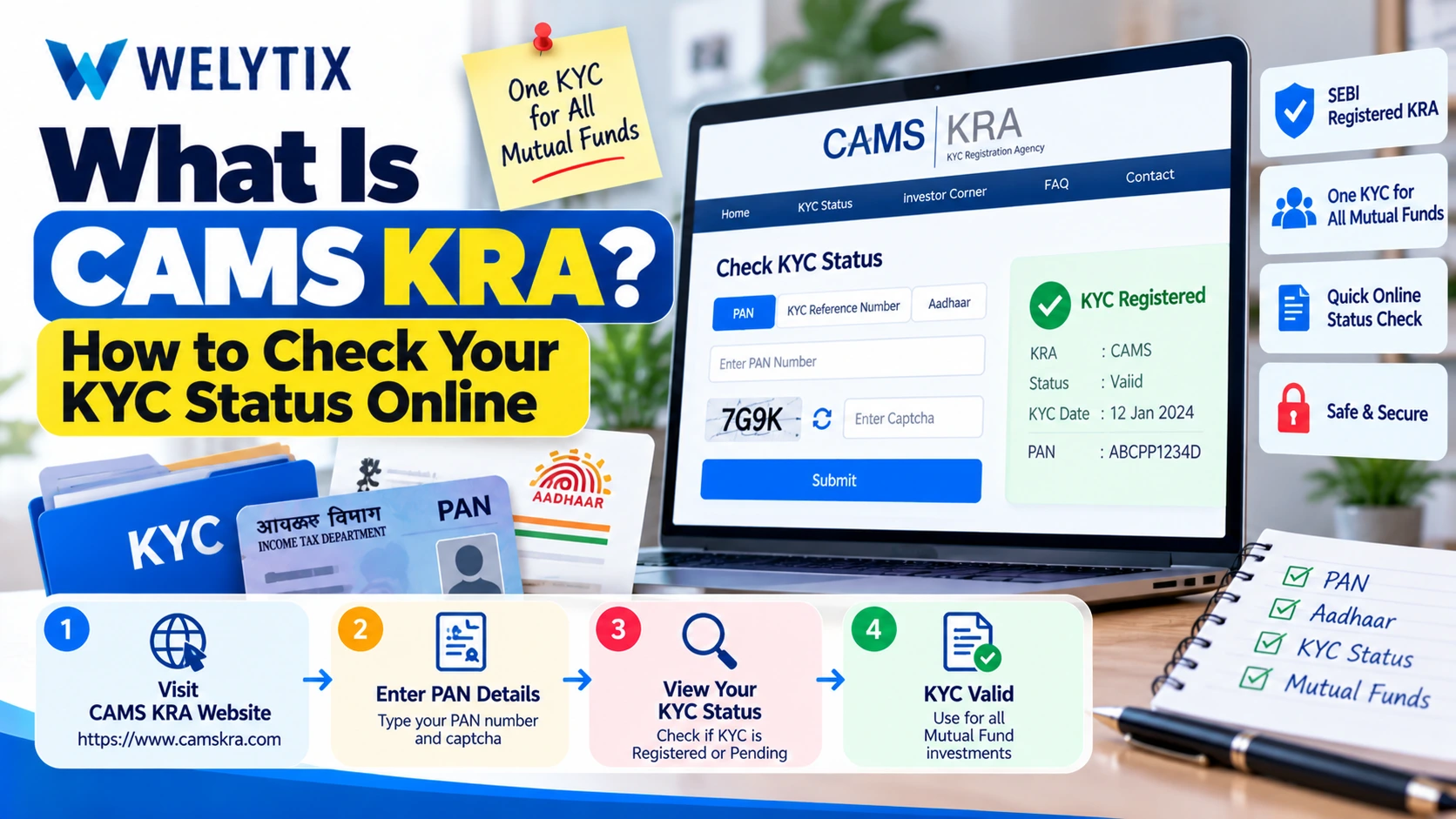
CAMS KRA is a SEBI-registered KYC Registration Agency (KRA) that stores and maintains investors' Know Your Customer (KYC) records in India. Once your KYC is registered with CAMS KRA, or with any other KRA, you can use it to invest in mutual funds and other securities across platforms. To check your status, enter your PAN on the CAMS KRA website. Last updated: October 2026.
Quick Facts About CAMS KRA
- CAMS KRA is one of the five KYC Registration Agencies registered with SEBI.
- KYC is a one-time process. A KYC registered with any KRA is accepted by SEBI-registered intermediaries such as mutual fund houses and brokers.
- You can check your KYC status online using only your PAN.
- The main statuses are Validated, Registered, Under Process, On Hold and Rejected.
- An "On Hold" status can stop you from investing in mutual funds until it is fixed.
What Is CAMS KRA?
CAMS KRA stands for Computer Age Management Services, KYC Registration Agency. It is a platform that collects, verifies and stores the KYC details of investors, such as name, address, date of birth, PAN and contact details. When you complete KYC through a mutual fund house, broker or investment platform, your details are uploaded to a KRA, and other intermediaries can then access them instead of asking you to start over.
What Is KYC?
KYC (Know Your Customer) is a regulatory requirement set by SEBI to verify the identity of investors. It helps prevent fraud, identity theft and money launderin
g. Without a valid KYC, you cannot invest in mutual funds or most other financial products.
The Five SEBI-Registered KRAs
CAMS KRA is one of five KRAs. They all follow the same SEBI rules.
| KRA | Linked to |
| CAMS KRA | CAMS (Computer Age Management Services) |
| CVL KRA | CDSL Ventures |
| NDML KRA | NSDL Database Management |
| DotEx KRA | NSE |
| KFin KRA | KFin Technologies |
You do not choose a KRA yourself. Your intermediary uploads your KYC to one of them, and the record is available to other intermediaries.
What Does CAMS KRA Do?
- Registers and verifies KYC records. It stores your identity and address details along with your PAN.
- Maintains a central database. SEBI-registered intermediaries can access it with your consent, which reduces repeated paperwork.
- Validates records against official databases. Details such as PAN and Aadhaar are checked, which is why a "Validated" status carries more weight than "Registered".
- Lets you check your status online. You can look up your KYC with your PAN at any time.
- Supports regulatory compliance. It helps intermediaries meet SEBI's KYC rules.
How to Check Your KYC Status on CAMS KRA
- Visit the official CAMS KRA website, camskra.com.
- Open the KYC status or KYC enquiry option on the home page.
- Enter your PAN.
- Submit the details, including any captcha shown.
- Read your status on the screen. It also shows which KRA holds your record.
If CAMS KRA shows no record, your KYC may be registered with another KRA. You can check the same PAN on the other KRA websites.
What Each KYC Status Means
| Status | What it means | What to do |
| Validated | Your KYC has been checked against official databases and is fully active. | Nothing. You can invest across platforms. |
| Registered | Your KYC is on record, but not fully validated. | You can usually continue with your existing fund houses. For a new fund house, you may need to validate your KYC. |
| Under Process | Your application is being processed. | Wait a few days, then check again. |
| On Hold | Something is missing or invalid, such as an unverified mobile number or email, or a PAN not linked to Aadhaar. | Fix the flagged issue. You may not be able to invest in mutual funds until then. |
| Rejected | Your application did not meet the documentation or verification requirements. | Resubmit with correct documents. |
| Not Registered | No KYC record was found. | Complete KYC before investing. |
What to Do If Your KYC Is On Hold or Rejected
The KRA portal usually displays the reason next to the status. The most common causes are:
- Mobile number or email not validated
- PAN not linked to Aadhaar
- A document or ID type that is not in the accepted list
- Details that do not match official records
To fix this, update the flagged detail through the KRA's online update page or through your mutual fund house, broker or platform. Once the correction is accepted, the status moves back to Registered or Validated.
How to Complete KYC Through a KRA
You usually start KYC with a SEBI-registered intermediary, such as a mutual fund house, broker or investment platform, which then uploads your record to a KRA.
Online KYC
- Choose a SEBI-registered intermediary and start the KYC process online.
- Enter your PAN, Aadhaar and registered mobile number and email.
- Verify your Aadhaar and contact details with the OTPs sent to you.
- Upload any documents requested, such as bank proof.
- Complete the in-person verification (IPV), which is often done through a video call.
- Submit the application and wait for confirmation. You can then check your status with your PAN.
Offline KYC
- Download the KYC form from the KRA or intermediary website.
- Fill it in and attach self-attested copies of your documents and photographs.
- Submit it to a SEBI-registered intermediary, which forwards it to the KRA for verification.
- Track the status online with your PAN. Offline applications can take longer than online ones.
Documents Required for KYC
- PAN card: mandatory
- Aadhaar or another valid proof of identity and address: such as passport, voter ID or driving licence, as accepted under SEBI rules
- Passport-size photograph
- Bank account proof: cancelled cheque or bank statement
- Valid mobile number and email address: these must be verified
Using Aadhaar-based verification with a PAN linked to Aadhaar generally leads to a "Validated" status.
Why Is KYC Compliance Important?
- Protects you: It reduces the risk of identity theft and fraud on your account.
- Required by law: SEBI rules require KYC for investing in mutual funds and other securities.
- Saves time: One KYC works across intermediaries, so you do not repeat the process every time you invest with a new platform.
- Keeps investing uninterrupted: An active status ensures your SIPs and redemptions are not blocked.
Frequently Asked Questions
What is CAMS KRA?
CAMS KRA is a SEBI-registered KYC Registration Agency run by CAMS. It collects, verifies and stores investors' KYC records so that SEBI-registered intermediaries can use them.
How can I check my KYC status online?
Visit the CAMS KRA website, open the KYC status option, enter your PAN and submit. The page shows your status and which KRA holds your record.
What does "KYC Under Process" mean?
It means your KYC application is still being verified. It can take a few days. If it stays pending for long, check whether any additional documents are needed.
What does "KYC On Hold" mean?
It means your record has a problem, such as an unverified mobile number or email, or a PAN that is not linked to Aadhaar. Fix the issue to restore your status.
Can I update my KYC details if they are incorrect?
Yes. You can submit a KYC modification request through your mutual fund house, broker or platform, or through the KRA's online update option.
What happens if my KYC is not registered?
You need to complete KYC before you can invest in mutual funds. Submit the required documents and complete verification through a SEBI-registered intermediary.
Is CAMS KRA the same as CAMS, the mutual fund registrar?
They are related but different. CAMS is a registrar and transfer agent for mutual funds. CAMS KRA is its KYC registration service.
Is KYC done with one KRA valid everywhere?
Yes. A KYC registered with any SEBI-registered KRA is accepted by SEBI-registered intermediaries, so you do not need to repeat it with each one.
Is there a fee to check my KYC status?
No. Checking your KYC status with your PAN on a KRA website is free.
Conclusion
CAMS KRA makes KYC a one-time process by keeping your verified details in a central database. Check your status every now and then, keep your mobile number, email and PAN-Aadhaar linkage up to date, and fix any "On Hold" status quickly so that your investments run without interruption.
Disclaimer: This article is for educational and informational purposes only and does not constitute investment, tax or legal advice. KYC rules and processes are set by SEBI and may change over time. Mutual fund investments are subject to market risks. Please read all scheme-related documents carefully before investing.