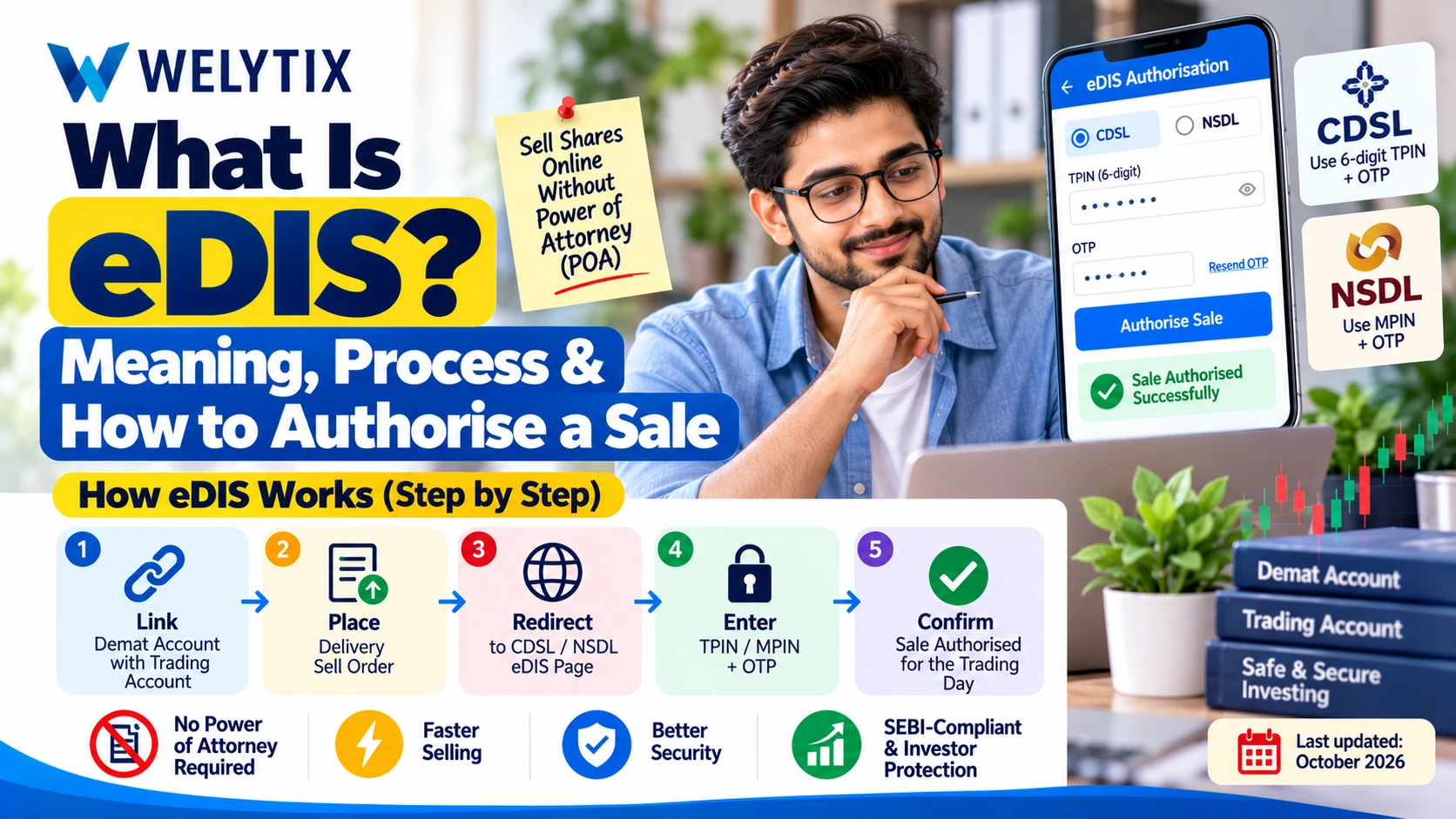
eDIS (Electronic Delivery Instruction Slip) is a SEBI-mandated digital facility that lets you authorise the sale of shares from your demat account online, without giving your broker a Power of Attorney (POA). When you place a delivery sell order, you approve it on the CDSL or NSDL page using a TPIN or MPIN and an OTP. Last updated: October 2026.
Quick Facts About eDIS
- eDIS stands for Electronic Delivery Instruction Slip. It replaces the paper delivery instruction slip (DIS).
- It works through the two depositories, CDSL and NSDL.
- CDSL users authorise with a 6-digit TPIN plus an OTP. NSDL users use their depository PIN (MPIN) plus an OTP.
- You need it to sell demat holdings for delivery if you have not given your broker a POA or DDPI.
- The authorisation is generally valid for the trading day.
What Is eDIS?
To understand eDIS, you first need to know the two depositories that hold shares in electronic form in India: NSDL (National Securities Depository Limited) and CDSL (Central Depository Services Limited). Your demat account sits with one of them, through your broker.
Earlier, selling shares from a demat account meant filling in and submitting a physical delivery instruction slip, which was slow and error-prone. eDIS digitises this step. When you sell, the depository asks you, the account holder, to approve the debit of your shares, so your broker cannot move them without your consent.
eDIS vs DDPI vs POA
There are three ways to authorise the debit of shares when you sell. eDIS is the one that asks for your approval each time.
| Method | What it is | Validity | Your control |
|---|---|---|---|
| eDIS (TPIN/MPIN + OTP) | You approve the sale on the depository's page | Generally the trading day | High: you approve each time |
| DDPI | A one-time standing instruction that can be given online, limited to specific purposes | Until you revoke it | Medium |
| POA | An older, broader authorisation signed offline | Until you revoke it | Lower: broad powers to the broker |
DDPI was introduced by SEBI in 2022 and is optional. If you signed a POA earlier, it can continue to work until you revoke it.
Why Is eDIS Important?
No Power of Attorney Required
You can sell shares from your demat account without handing your broker a POA. This keeps control of your holdings with you.
Faster Selling
There is no paperwork. Once you place the sell order, authorisation takes a few clicks on the depository's page.
Better Security
The depository verifies each sale with two factors: your TPIN or MPIN and an OTP sent to your registered mobile number and email. This reduces the risk of unauthorised debits from your account.
Regulatory Compliance
eDIS follows the framework set by SEBI and implemented by CDSL and NSDL, which adds transparency and investor protection to the selling process.
Convenience
You can authorise a sale from anywhere, using your phone or computer, as long as your registered mobile number and email are active.
How to Authorise a Share Sale Using eDIS
- Link your accounts. Make sure your demat account is linked to your trading account. Your broker normally does this when you open the account.
- Place a delivery sell order. Log in to your trading platform, choose the shares you hold, enter the quantity and price, and place the order.
- Click the authorisation prompt. Your platform will ask you to authorise the transfer and redirect you to the CDSL or NSDL page.
- Enter your TPIN or MPIN and the OTP. The OTP is sent to the mobile number and email registered with the depository.
- Confirm. Once verified, the shares are debited for the sale. Sale proceeds are credited according to the exchange settlement cycle, which is generally the next working day.
How to Generate or Change Your CDSL TPIN
If you do not have a TPIN, you can generate one on the CDSL eDIS website using your demat details. The TPIN is sent to your registered mobile number and email. You can reset or change it on the same website whenever you need to. NSDL account holders can set up their PIN through the NSDL portal.
Common eDIS Problems and How to Fix Them
- OTP not received: Check that your mobile number and email are registered with your depository, and check your spam folder. If they are outdated, update them through your broker.
- Authorisation link expired: The session is time-limited. Complete the steps quickly, or place the order again to get a fresh link.
- Page not loading: Clear your browser cache or switch to another browser. If it persists, contact your broker's support.
- Wrong TPIN: You will not be able to authorise the sale. Repeated wrong attempts can block the TPIN, so reset it through the depository website.
- Process looks different on your platform: The screens vary by broker, but the depository step is the same.
Is eDIS Mandatory?
eDIS is required to sell demat holdings for delivery if you have not given your broker a POA or DDPI. If you have signed either one, your broker can debit the shares for your sell orders without a separate eDIS authorisation. Providing a POA or DDPI is optional, and you can choose eDIS instead.
Frequently Asked Questions
What does eDIS stand for?
eDIS stands for Electronic Delivery Instruction Slip. It is the digital replacement for the paper slip used to instruct the transfer of shares out of a demat account.
Is eDIS mandatory to sell shares?
It is required if you have not given your broker a POA or DDPI. If you have either, you can sell without a separate eDIS authorisation.
What is a TPIN in eDIS?
A TPIN is a 6-digit Transaction PIN issued by CDSL. You enter it, along with an OTP, to authorise the sale of shares from your CDSL demat account.
What happens if I enter the wrong TPIN?
The authorisation will not go through. If you enter it wrongly several times, it may be blocked, in which case you can generate a new TPIN from the depository website.
Do I need to authorise every sale with eDIS?
The authorisation is generally valid for the trading day, so you may not need to repeat it for additional holdings sold on the same day. You will need to authorise again on another day, unless you use DDPI or POA.
Are there any charges for using eDIS?
eDIS itself is generally free of charge. However, your broker's usual depository participant (DP) charges for selling shares still apply, so check your broker's fee schedule.
Can I change my TPIN?
Yes. You can change or reset your TPIN on the CDSL eDIS website, and the new PIN is sent to your registered mobile number and email.
Is eDIS needed for intraday trades?
No. eDIS applies when you sell shares held in your demat account for delivery. Intraday trades are squared off within the day and do not need it.
Conclusion
eDIS gives you control over when your shares leave your demat account, without the paperwork of a physical slip or the broad powers of a POA. Keep your mobile number and email updated with your depository, remember your TPIN or MPIN, and you can authorise a sale in a few clicks.
Also read: 10 Types of Investments in India
Disclaimer: This article is for educational and informational purposes only and does not constitute investment, tax or legal advice. Rules and processes may vary by depository and broker and may change over time. Investments in securities markets are subject to market risks. Please read all related documents carefully and consult a qualified financial advisor before investing.