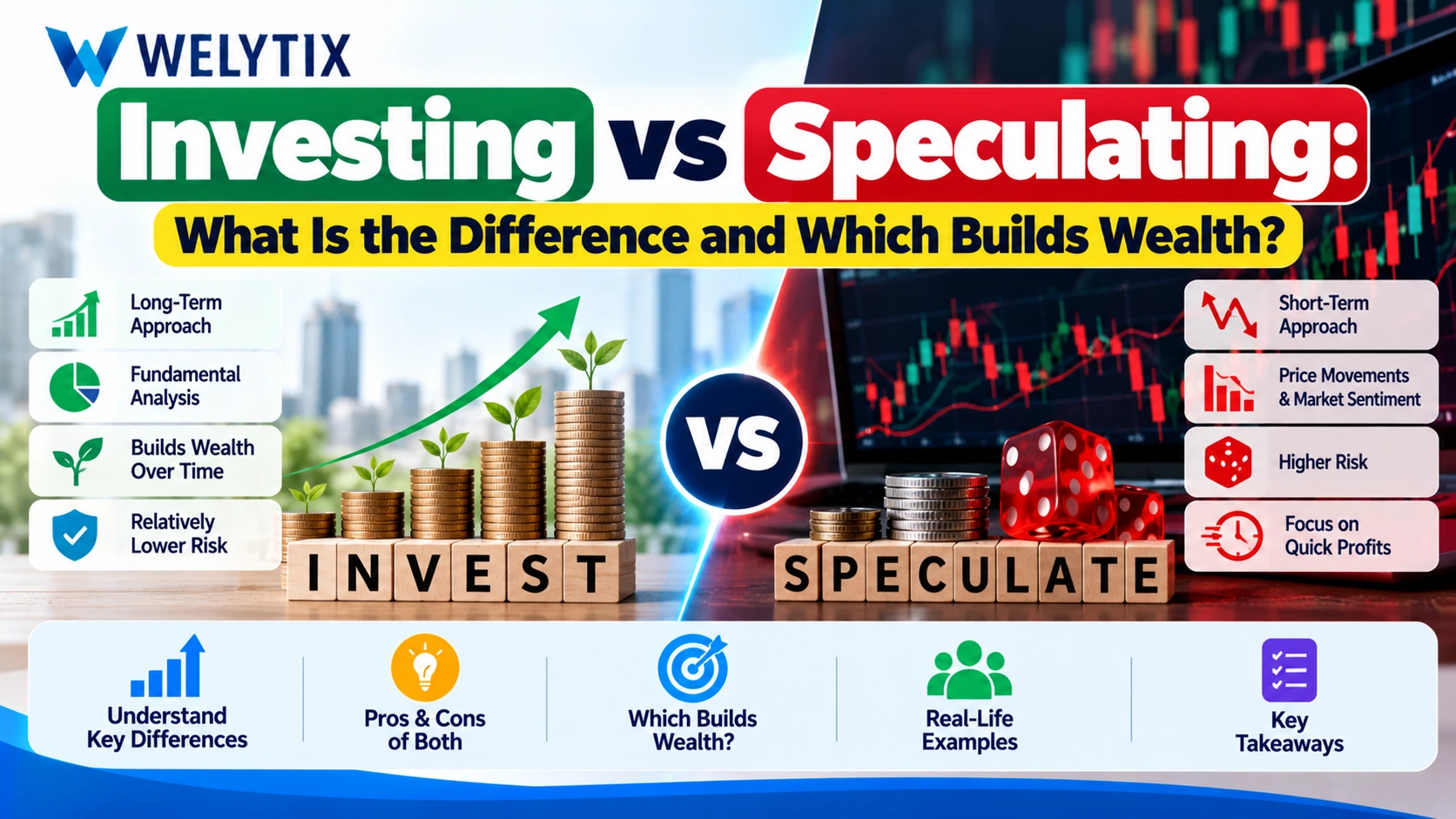
Investing means putting money into assets based on research, with a long-term goal of building wealth steadily. Speculating means taking short-term bets on price movements, hoping to profit quickly, and it carries much higher uncertainty. The real difference is not what you buy, but why you buy it and how long you plan to stay in. Last updated: October 2026.
Quick Facts: Investing vs Speculating
- Investing is long-term, research-based and aims at steady wealth creation through compounding.
- Speculating is short-term, price-driven and aims at quick gains from market movements.
- Both involve risk, but speculation depends far more on timing and luck.
- Buying the same stock can be either, depending on your reason and time horizon.
- Speculation is not always wrong, but it should be a small, deliberate part of your money, not the foundation.
What Is Investing?
Investing is the practice of putting your money into assets such as stocks, mutual funds, bonds or real estate, with the aim of growing it over a long period. An investor asks, "Is this worth holding for the next 5 or 10 years?" The decision rests on understanding the asset, its fundamentals and how it fits your financial goals.
Example: Someone who invests in a mutual fund through a monthly SIP for 15 years is investing. They stay invested through market ups and downs and let compounding work over time.
What Is Speculating?
Speculating is buying and selling assets mainly to profit from short-term price changes, often within days, weeks or even a single day. A speculator asks, "Can this go up in the next few days?" The decision rests on timing, charts, trends and market sentiment rather than the underlying value.
Example: Someone who buys a stock because it is trending online and plans to sell after a quick rise is speculating.
Investing vs Speculating: Key Differences
| Factor | Investing | Speculating |
| Goal | Build wealth steadily | Make quick profits |
| Time horizon | Years | Days, weeks or intraday |
| Basis for decisions | Research and fundamentals | Price movements, trends and timing |
| Risk | Planned and spread across assets | High and concentrated |
| Source of returns | Growth, income and compounding | Price changes in the short term |
| Behaviour | Patient and disciplined | Reactive and fast-moving |
| Role in a portfolio | Core foundation | Small, optional portion |
A Real-Life Example: Rohit and Karan
Rohit invests in a company after understanding how it earns money, where it is growing and why it makes sense to hold for years. When markets fall, he does not panic, because his decision was never based on short-term movement.
Karan buys a stock because it is trending on social media. It has already risen sharply, and he hopes it rises a little more so he can exit quickly. Sometimes he makes fast money. Sometimes he gets stuck.
Over time, Rohit's approach tends to build something far more stable.
The Differences That Actually Matter
Time Horizon
Investing is a long-term approach, where you stay invested for years and let compounding do its work. Speculating is short-term. Someone doing SIPs for 15 years is investing, while someone entering and exiting stocks every week is speculating.
Risk and Stability
Investing involves risk, but it is planned. You spread your money across assets, focus on quality and stay patient through ups and downs. Speculation depends on prices moving in your favour within a short window, and they can move either way very quickly.
Research vs Reaction
Investors try to understand what they are buying, including the business, its performance and its future potential. Speculators focus on timing, charts and what the market is doing right now. One is about value, and the other is about movement.
Discipline vs Impulse
Investing needs patience and sticking to a plan even when the market tests you. Speculation often leads to quick decisions driven by news, trends or fear of missing out.
Why Do People Confuse Investing and Speculating?
Today, trading apps are in everyone's pocket, market updates are constant, and tips, reels and opinions are everywhere. It is easy to feel like you are investing simply because you are active. But activity is not a strategy. Buying and selling frequently without a clear reason is not investing. It is just movement.
What the Data Shows About Short-Term Trading
SEBI's study of individual traders in the equity derivatives (F&O) segment found that about 87.7% of individual traders made net losses in FY26, with aggregate losses of around ₹91,685 crore. Most of these losses came from options trading. This segment is one of the most speculative and leveraged parts of the market, so it should not be read as a verdict on all short-term trading, but it shows how hard it is to profit from short-term price moves consistently.
Investing vs Gambling: Where Is the Line?
If you put money into something you do not understand, only because you heard it might go up, that is not investing. It is hoping. Warning signs that speculation is turning into gambling include:
- Buying a stock because someone said it will double
- Entering a trade because "this always works"
- Putting in money without knowing the risk or the exit plan
- Using money you cannot afford to lose
At that point, losses tend to hurt the most.
Is Speculating Always Bad?
Not necessarily. Some professionals speculate with strict rules, a clear understanding of risk and defined entry and exit points. What matters is clarity. The problem begins when someone believes they are investing but is actually speculating without a plan.
How to Tell Whether You Are Investing or Speculating
Ask yourself these questions:
- Can I explain what I am buying and why? If not, you may be speculating.
- How long do I plan to hold? A few days or weeks points to speculation; years points to investing.
- What would make me sell? A change in the business or your goal suggests investing; a small price dip or a tip suggests speculating.
- Is this tied to a financial goal? Investing usually is.
- Can I afford to lose this money? If not, it should not be used for speculation.
What Should You Do?
Start with honest self-assessment. If your goal is long-term wealth, your core strategy should be investing:
- Stay consistent with regular investments, such as SIPs
- Focus on quality assets and diversify
- Give your money time to grow
- Ignore unnecessary market noise
You can still explore short-term opportunities, but keep them limited and use only money you can afford to put at risk. Keep this separate from your long-term investments so that a bad trade does not disturb your financial goals.
Frequently Asked Questions
What is the difference between investing and speculating?
Investing focuses on long-term wealth creation based on research, while speculating focuses on short-term gains from price movements.
Can you lose money while investing?
Yes. All market-linked investments carry risk. Investing aims to manage that risk through research, diversification and time.
How do I know whether I am investing or speculating?
If your decisions are based on long-term goals and an understanding of what you own, you are investing. If they are based on short-term price movements, you are most likely speculating.
Is speculation the same as gambling?
Not exactly, but without knowledge, rules and discipline, speculation can become very similar to gambling.
Can I do both investing and speculating at the same time?
Yes, but keep them separate. Your long-term investments should not be affected by short-term trades, and you should speculate only with money you can afford to put at risk.
Is trading the same as speculating?
Often, but not always. Short-term trading is mostly speculative because it depends on price movements. Some traders follow strict rules and risk limits, which makes it a disciplined activity, but it still carries high uncertainty.
Is a SIP investing or speculating?
A SIP in a mutual fund, held for years, is an investing approach. It is still market-linked, so returns are not guaranteed.
Conclusion
This is not about choosing one and rejecting the other completely. It is about knowing what you are doing at any given moment. Investing builds wealth quietly over time, while speculating tries to speed up gains at the cost of higher uncertainty. The real problem is confusion between the two, and clarity is what protects you.
Also read: The New Direct Tax Code
Disclaimer: This article is for educational and informational purposes only and does not constitute investment, tax or legal advice. Statistics mentioned are from SEBI studies and may change. Investments in securities markets are subject to market risks. Please read all related documents carefully and consult a qualified financial advisor before investing.