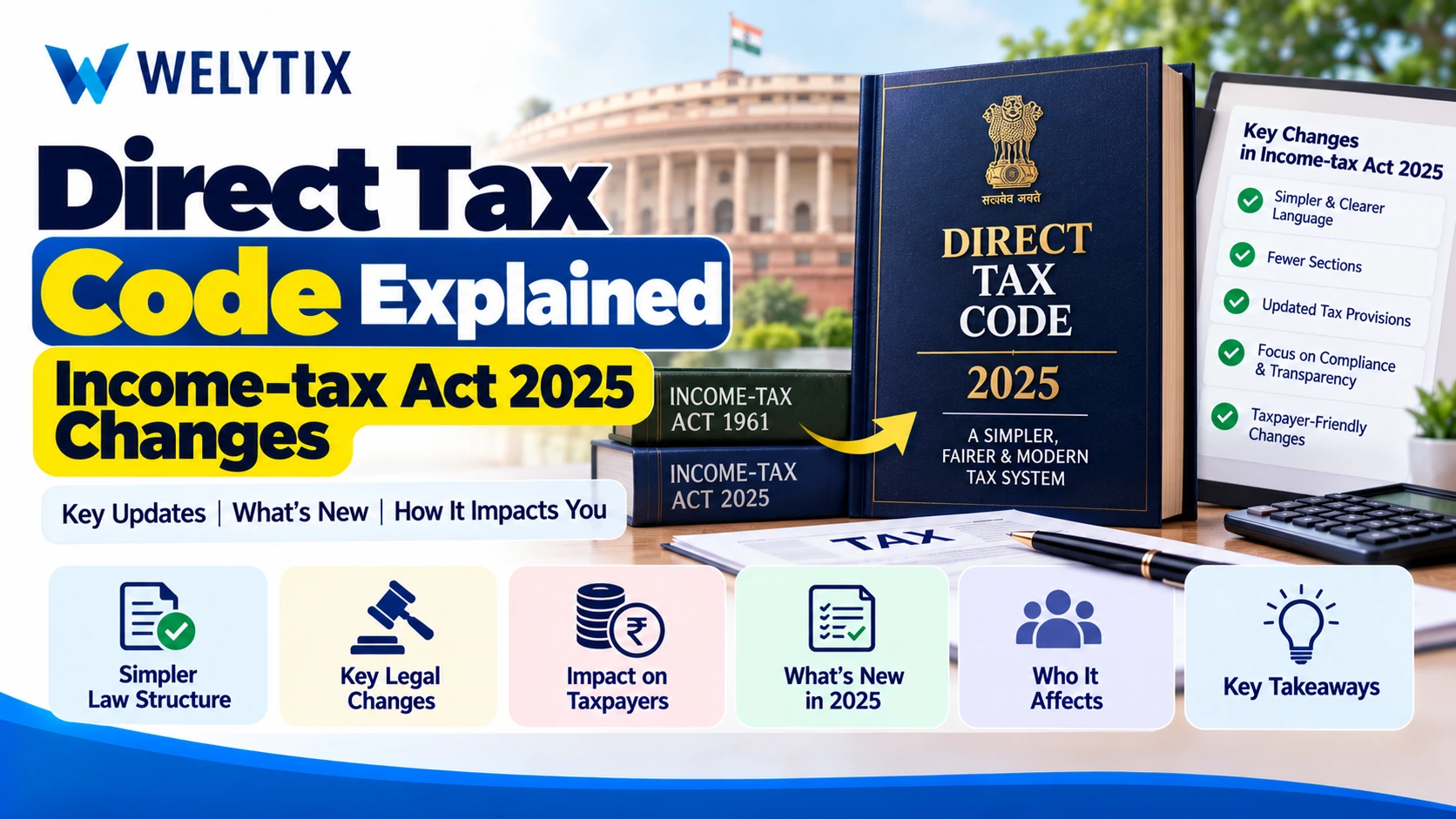
The Direct Tax Code (DTC) was a long-proposed plan to replace India's Income-tax Act, 1961 with a simpler law. That reform has now arrived as the Income-tax Act, 2025, which came into effect on 1 April 2026. It restructures the law with fewer sections, simpler language and a single "Tax Year", while income tax slabs and rates remain largely unchanged. Last updated: October 2026.
Quick Facts About the Direct Tax Code
- The Direct Tax Code was first proposed in 2009 to replace the Income-tax Act, 1961, but the original DTC Bill never became law.
- The reform finally arrived as the Income-tax Act, 2025 (Act No. 30 of 2025), which received presidential assent on 21 August 2025.
- The new Act applies from 1 April 2026, covering income from Tax Year 2026-27 onwards.
- It replaces "Previous Year" and "Assessment Year" with a single "Tax Year".
- Tax slabs and rates did not change significantly. The reform is mainly about structure, language and compliance.
- Returns, notices and proceedings for FY 2025-26 and earlier continue under the old law.
What Is the Direct Tax Code?
The Direct Tax Code is the name given to India's effort to rewrite its direct tax law. Direct taxes are those paid directly by the taxpayer to the government, such as income tax and corporate tax. The Income-tax Act, 1961 had been amended so many times that it had become long, complicated and hard to interpret, which led to confusion and a large number of tax disputes.
The DTC aimed to:
- Simplify tax laws and language
- Reduce disputes and litigation
- Make compliance easier for individuals and businesses
- Make the tax system more transparent
Direct Tax Code vs Income-tax Act, 2025: Are They the Same?
Not exactly. "Direct Tax Code" refers to the earlier drafts and proposals made over many years. The Income-tax Act, 2025 is the law that was actually passed and now delivers the same goal of a simpler direct tax law.
It is best described as a rewrite of the existing law in a clearer form, rather than a complete overhaul of tax policy. Many of the more dramatic ideas from the early DTC drafts did not become part of the final Act.
Timeline of the Reform
| When | What happened |
| 2009 | The first Direct Tax Code draft was released. |
| 2010 | A DTC Bill was introduced in Parliament, but it never became law. |
| 21 August 2025 | The Income-tax Act, 2025 received presidential assent. |
| 1 February 2026 | Union Budget 2026 confirmed the Act would apply from 1 April 2026. |
| February to March 2026 | Draft Income-tax Rules, 2026 were released and the final rules were notified. |
| 1 April 2026 | The Income-tax Act, 2025 and the Income-tax Rules, 2026 came into force. |
Key Changes Under the Income-tax Act, 2025
A Shorter, Better-Organised Law
The new Act has 536 sections, 23 chapters and 16 schedules. This is roughly 35% fewer sections and about half as many chapters as the 1961 Act. Related provisions are grouped together and some of the details are moved into tables and schedules, which makes the law easier to read.
One "Tax Year" Instead of Two Terms
The old law used "Previous Year" (the year you earn income) and "Assessment Year" (the year it is assessed). The new Act replaces both with a single Tax Year. For example, income earned between 1 April 2026 and 31 March 2027 falls in Tax Year 2026-27.
Simpler Language and Fewer Rules and Forms
The Income-tax Rules, 2026 reduce the number of rules from 511 to 333 and the number of forms from 399 to 190. Several commonly used forms have also been renumbered:
| Earlier form | New form | Purpose |
| Form 16 | Form 130 | TDS certificate for salary |
| Form 26AS | Form 168 | Tax credit statement |
| Forms 15G and 15H | Form 121 | Declaration to avoid TDS on interest |
Reorganised TDS and TCS Provisions
Tax deducted at source (TDS) and tax collected at source (TCS) rules have been reorganised and renumbered to make them easier to follow. The aim is simplification and better compliance, rather than a complete change in how tax is deducted or collected.
Tax Slabs and Rates
Budget 2026 did not make major changes to income tax slabs or rates. The new tax regime continues to be the default regime for individuals, and the option to choose between regimes remains. Check the current slabs for your income level before filing.
What Has Not Changed
The Income-tax Act, 2025 is mainly a restructuring. In practice:
- Your basic tax slabs and rates remain broadly the same.
- Your investments are generally taxed on the same basis as before, although Budget 2026 made some year-specific changes, so check current rules for your investments.
- Returns for FY 2025-26 and earlier years are still governed by the Income-tax Act, 1961.
How Does the New Law Affect You?
If You Are a Salaried Employee
You will see new form numbers, such as Form 130 in place of Form 16, and the term "Tax Year" on documents from the 2026-27 period onwards. Your tax calculation is not expected to change just because of the new law.
If You Are an Investor
Your investment tax planning stays broadly the same, but it is worth checking current capital gains and other rates each year, since Budget announcements can change them. Keep your records organised, as statements and forms may carry new names.
If You Run a Business or Are a Professional
Businesses and professionals should expect updates to accounting and payroll systems, new form numbers and revised compliance procedures. Tax audit reports, advance tax and TDS filings follow the new framework from 1 April 2026.
Benefits of the New Framework
- Clarity: Simpler language and a more logical structure make the law easier to understand.
- Fewer disputes: Clearer provisions can reduce differences in interpretation and litigation.
- Easier compliance: Fewer rules and forms reduce paperwork.
- Consistency: A single Tax Year concept makes record keeping easier.
Challenges to Expect
- Transition effort: Taxpayers, professionals and software systems need time to adapt to new section numbers and forms.
- Two laws at once: For some years, old matters will continue under the 1961 Act while new income falls under the 2025 Act.
- Ongoing amendments: Finance Acts can still change specific provisions each year.
Frequently Asked Questions
What is the Direct Tax Code?
The Direct Tax Code is India's proposal to replace the Income-tax Act, 1961 with a simpler direct tax law. It has now been delivered through the Income-tax Act, 2025.
Has the Direct Tax Code been implemented?
Yes, in the form of the Income-tax Act, 2025, which came into effect on 1 April 2026. The original DTC Bills proposed in 2009 and 2010 were never enacted.
When did the Income-tax Act, 2025 come into effect?
It came into effect on 1 April 2026 and applies to income from Tax Year 2026-27 onwards.
What is a Tax Year?
A Tax Year is the single period used for both earning and assessing income under the new Act. It replaces the earlier terms Previous Year and Assessment Year.
Will my income tax slabs change under the new Act?
No major change in slabs or rates was made by the new Act or Budget 2026. Check the latest slabs for your income level before filing.
Does the old income tax law still apply?
Yes, for earlier periods. Returns, assessments and notices relating to FY 2025-26 and before continue under the Income-tax Act, 1961.
What happened to Form 16 and Form 26AS?
Under the Income-tax Rules, 2026, Form 16 is now Form 130 and Form 26AS is now Form 168.
Do I need to take any action because of the new Act?
Most taxpayers do not need to take special action. Keep an eye on the new form numbers and deadlines, and consult a tax professional if you have a complex situation.
Conclusion
The Direct Tax Code has finally become reality through the Income-tax Act, 2025. It brings a shorter, clearer law, a single Tax Year and fewer forms, without major changes in tax rates. For most taxpayers, the biggest change is in the paperwork and terminology, not the amount of tax. Stay updated on the new forms and rules, and review your tax planning each year.
Sources and further reading: Income-tax Act, 2025 (Act No. 30 of 2025); Income-tax Rules, 2026 notified by the CBDT; Union Budget 2026 documents.
Disclaimer: This article is for educational and informational purposes only and does not constitute tax, investment or legal advice. Tax laws, rates and rules can change. Please refer to the official Income Tax Department website or consult a qualified tax professional for your specific situation.