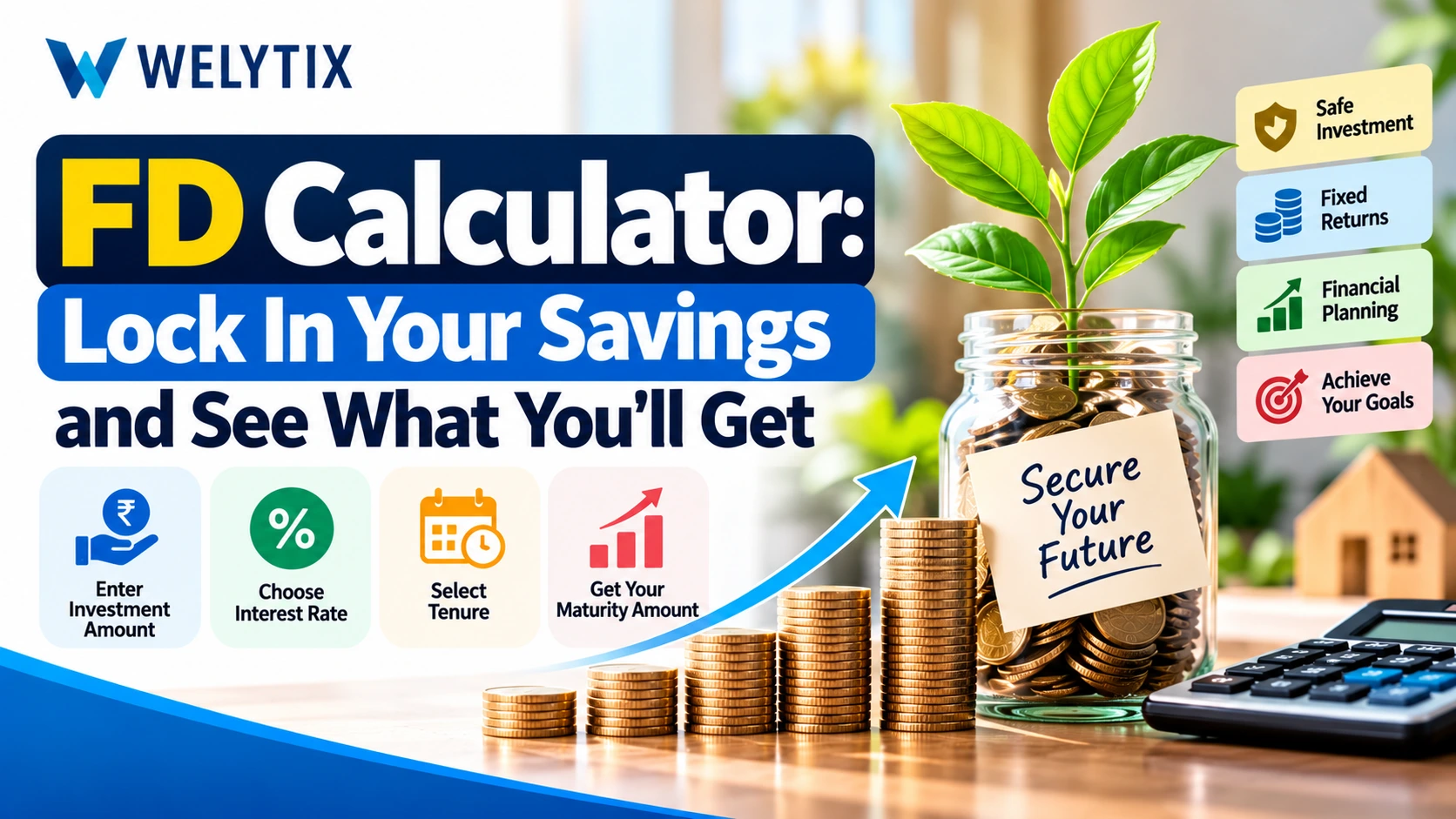
Want to know exactly how much your fixed deposit will be worth before you open it? An FD calculator tells you in seconds. No formulas, no guesswork. Let’s walk through how it works.
What is an FD Calculator?
An FD calculator is a free online tool that shows the maturity amount and interest earned on a fixed deposit, based on your deposit amount, interest rate and tenure.
FD stands for Fixed Deposit. You deposit a lump sum with a bank or NBFC for a fixed period at a pre-decided interest rate. Because the rate is locked in, your returns do not depend on the market. The calculator shows your total investment, the interest earned and the final maturity value.
Quick note: The result is an estimate. Banks may compound interest at different intervals and round amounts differently, so your actual maturity amount can vary slightly.
The FD formula (simple version)
A = P × (1 + r/n)^(n × t)
| Letter | What it means |
|---|---|
| A | Maturity amount |
| P | Principal (your deposit amount) |
| r | Annual interest rate (as a decimal, so 6.5% = 0.065) |
| n | Number of times interest is compounded per year (quarterly = 4) |
| t | Tenure in years |
Interest earned is simply A − P. The Welytix FD Calculator does this for you, so you only need to enter three numbers.
How to use the FD Calculator
- Enter your Total Investment (₹), for example ₹1,00,000.
- Enter the Interest Rate (% p.a.), for example 6.5%.
- Enter the Tenure (Years), for example 3.
- Click Calculate Now to see your maturity value and interest earned.
Tip: If your tenure is in months, convert it to years. For example, 18 months is 1.5 years.
Let’s see an example
Say you deposit ₹1,00,000 at 6.5% per year for 3 years, with interest compounded quarterly.
| Detail | Amount (approx.) |
|---|---|
| You deposited | ₹1,00,000 |
| Interest earned | ₹21,341 |
| Maturity amount | ₹1,21,341 |
Your ₹1 lakh grows to about ₹1.21 lakh, with no market risk along the way.
How does tenure change the result?
(₹1,00,000 at 6.5%, compounded quarterly)
| Tenure | Interest earned | Approx. maturity amount |
|---|---|---|
| 1 year | ₹6,660 | ₹1,06,660 |
| 3 years | ₹21,341 | ₹1,21,341 |
| 5 years | ₹38,042 | ₹1,38,042 |
| 10 years | ₹90,556 | ₹1,90,556 |
Notice that 10 years earns more than double the interest of 5 years. That’s compounding: your interest starts earning interest.
Does compounding frequency matter?
(₹1,00,000 at 7% for 5 years)
| Compounding | Maturity amount |
|---|---|
| Yearly | ₹1,40,255 |
| Half-yearly | ₹1,41,060 |
| Quarterly | ₹1,41,478 |
| Monthly | ₹1,41,763 |
The difference is small. The interest rate and tenure matter far more than how often interest is compounded.
Key features of a fixed deposit
- Guaranteed returns: The interest rate is locked in when you open the FD.
- Flexible tenures: Usually from 7 days up to 10 years.
- Senior citizen benefit: Most banks offer around 0.25% to 0.50% extra interest.
- Premature withdrawal: Allowed, but usually with a penalty of about 0.5% to 1%.
- Tax-saving FD: A 5-year lock-in FD can qualify for a deduction under Section 80C (old tax regime only).
FD interest and tax: what you should know
FD interest is added to your income and taxed as per your slab. Banks also deduct TDS (tax deducted at source) once your interest crosses a limit.
| Who | TDS applies when interest from one bank crosses |
|---|---|
| Regular depositors | ₹50,000 a year |
| Senior citizens | ₹1,00,000 a year |
- TDS is 10% if you have given your PAN, and 20% if you haven’t.
- If your total income is below the taxable limit, you can submit Form 15G (regular) or Form 15H (senior citizens) to avoid TDS.
- Even if no TDS is deducted, you still have to report the interest in your income tax return.
These limits and rates can change, so confirm the latest rules with your bank or a tax advisor.
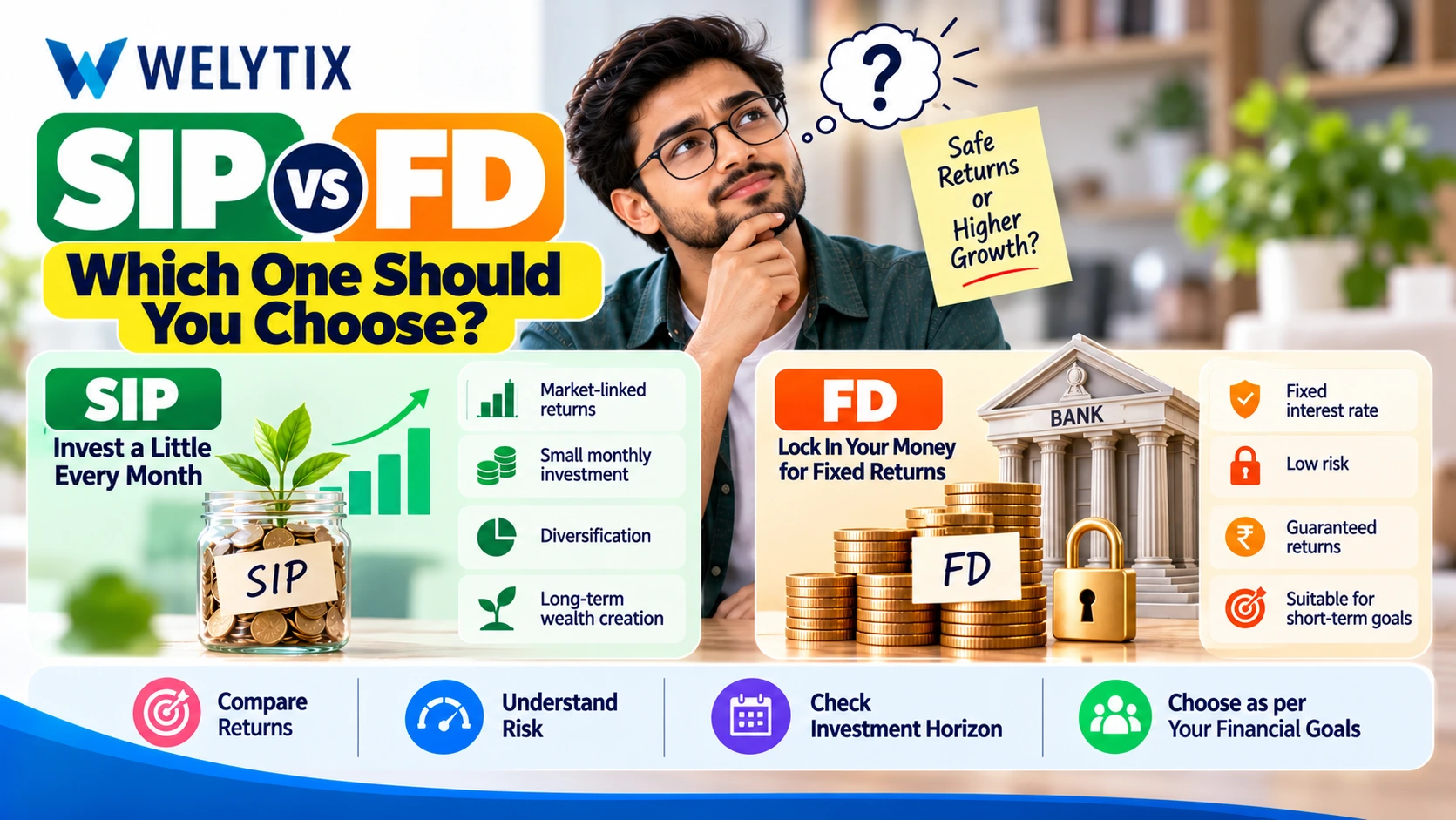
FD vs RD vs SIP: what’s the difference?
| Point | FD | RD | SIP |
|---|---|---|---|
| How you invest | One lump sum | Fixed amount every month | Fixed amount every month |
| Returns | Fixed, known upfront | Fixed, known upfront | Market-linked, not guaranteed |
| Risk | Very low | Very low | Higher |
| Best for | Safe parking of a lump sum | Building a saving habit | Long-term wealth building |
Got a lump sum? An FD fits. Saving from your monthly salary? Try the RD Calculator or the SIP Calculator.
Why use an FD calculator?
- Know your returns upfront: See the exact maturity amount before you commit.
- Compare banks: Enter different interest rates and see which offer pays more.
- Pick the right tenure: Find the balance between returns and how long your money stays locked.
- No math needed: Skip the formula and the spreadsheet.
Common mistakes to avoid
- Ignoring tax. The interest you see in the calculator is before tax.
- Not comparing rates. Even a 0.5% difference adds up over the years.
- Breaking the FD early. You may lose part of the interest to a penalty.
- Putting everything in one bank. Deposit insurance covers up to ₹5 lakh per depositor per bank, so spread large deposits.
- Locking all your money. Keep some cash easily available for emergencies.
- Forgetting inflation. Check your real returns with the Inflation Calculator.
Frequently Asked Questions
How is FD interest calculated?
FD interest is calculated using the formula A = P × (1 + r/n)^(n × t), where P is your deposit, r is the annual rate, n is the number of compounding periods per year and t is the tenure in years. Most banks compound interest quarterly.
How much will ₹1 lakh become in 3 years at 6.5%?
With quarterly compounding, ₹1,00,000 grows to about ₹1,21,341 in 3 years. Your interest earned is about ₹21,341.
What is the tenure of an FD?
Most banks offer tenures from 7 days up to 10 years. The rate you get usually depends on the tenure you choose.
Is FD interest taxable?
Yes. The interest is added to your income and taxed as per your slab. Banks deduct TDS if interest from one bank crosses ₹50,000 a year (₹1,00,000 for senior citizens). Check the latest rules with your bank.
Can I withdraw my FD before maturity?
Yes, most banks allow it, but they usually charge a penalty of about 0.5% to 1% on the interest rate.
Do senior citizens get higher FD interest?
Yes. Most banks offer around 0.25% to 0.50% extra interest to senior citizens. The exact benefit depends on the bank.
Is FD better than RD?
They suit different needs. An FD is for a lump sum you can invest at once, while an RD is for saving a fixed amount every month. Compare both with the RD Calculator.
Related calculators
Browse all tools on the Welytix Financial Calculators page.
Final thoughts
An FD is one of the simplest and safest ways to grow a lump sum. Open the Welytix FD Calculator, enter your amount, rate and tenure, and see exactly what you’ll get.
Disclaimer: This content is for educational purposes only and is not financial advice. Interest rates and tax rules change, so please confirm current details with your bank or a qualified advisor.